When people write to us about a screw conveyor, the first questions are usually “how much will it convey” and “what motor does it need”. Both can be worked out with a simple calculation if we know the material, the dimensions and the speed. Here we show the formulas we use for a first estimate, with an example for cement.
What determines screw conveyor capacity
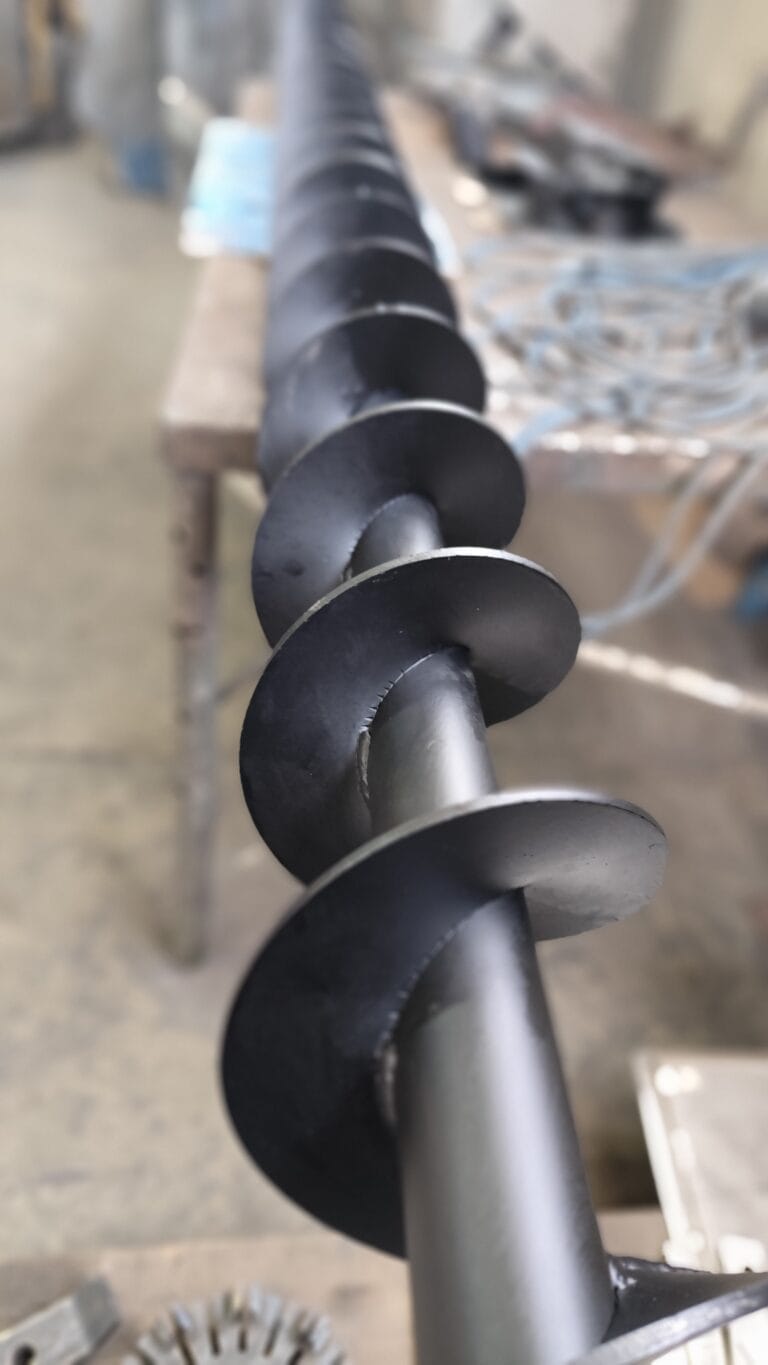
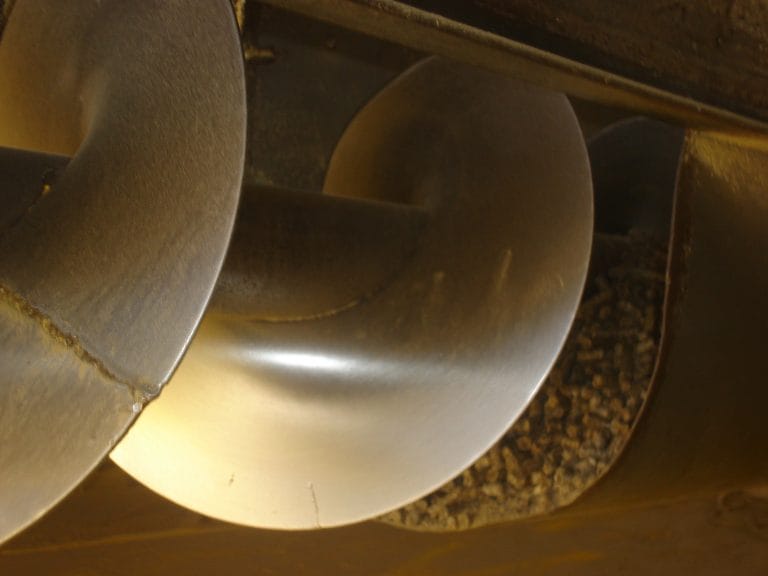
A screw conveyor moves material by pushing it forward with each turn. In one revolution the material moves by one pitch of the flight. Capacity depends on five things:
- Flight diameter (D) – the larger it is, the more material in the cross-section.
- Pitch (S) – the distance between two turns. Most often it equals the diameter.
- Speed (n) – how many times a minute the screw turns.
- Fill factor (ψ) – what part of the cross-section is filled with material. A screw conveyor never runs completely full.
- Incline (k) – on an inclined conveyor some material falls back, and capacity drops.
Capacity formula
Q = 47 × D² × S × n × ψ × ρ × k [t/h]
- D – flight diameter, m
- S – pitch, m
- n – speed, rpm
- ψ – fill factor
- ρ – bulk density of the material, t/m³
- k – incline factor
The number 47 comes from 60 minutes × π/4 (the area of the circle). If you leave out ρ, you get the volume in m³/h.
How full the conveyor should be
The more abrasive and heavy the material, the less the conveyor is filled – otherwise the flight and casing wear quickly.
| Material | Example | Fill factor ψ |
|---|---|---|
| Light, non-abrasive | grain, flour, pellets | 0,45 |
| Mildly abrasive | coal, soil | 0,30 |
| Moderately abrasive | cement | 0,25 |
| Heavy, highly abrasive | sand, gravel, ash | 0,15 |
How much is lost on an incline
| Incline | 0° | 5° | 10° | 15° | 20° |
|---|---|---|---|---|---|
| Factor k | 1,0 | 0,9 | 0,8 | 0,7 | 0,6 |
Above 20–25° the calculation is no longer enough – steep conveyors use a shorter pitch and higher speed, and capacity is checked separately.
Power formula
P = Q × (f × L + H) / 367 [kW]
- Q – capacity, t/h
- L – horizontal length, m
- H – lift height, m
- f – material resistance factor: about 2 for grain, 3 for cement, 5 for sand and gravel
This gives the shaft power. We add the gearbox losses (divide by about 0.85) and a margin for starting under load. Then we choose the nearest standard motor size up.
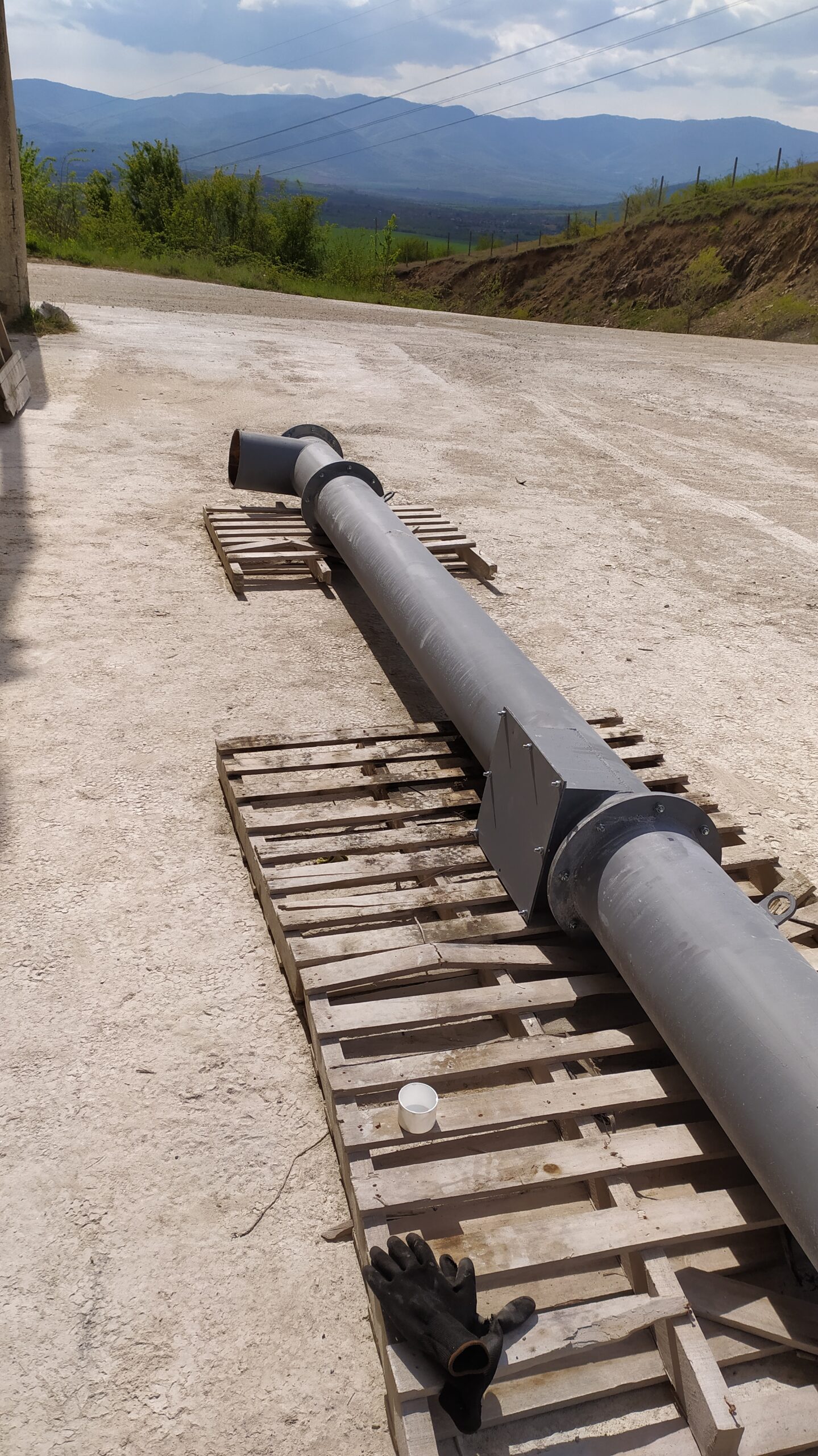
Example: cement screw conveyor
Horizontal screw conveyor for cement, length 6 m:
- D = 0.25 m, S = 0.25 m, n = 60 rpm
- ψ = 0.25 (cement), ρ = 1.2 t/m³, k = 1 (no incline)
Capacity: Q = 47 × 0.25² × 0.25 × 60 × 0.25 × 1.2 × 1 ≈ 13 t/h
Shaft power: P = 13.3 × (3 × 6 + 0) / 367 ≈ 0.65 kW. With gearbox losses – about 0.76 kW. We choose a 1.1 kW geared motor, to have a margin when starting with a full conveyor.
If the same conveyor is inclined at 15°, at the same speed the capacity drops to about 9 t/h (k = 0.7). To keep 13 t/h, you need a larger diameter or a higher speed – and therefore a stronger motor.
When the calculation is not enough
The formulas give a good first estimate, but in practice we also check:
- Wear with abrasive materials – with sand and cement the flight and casing wear faster, so we use wear-resistant or thicker steel there.
- Moisture and caking – wet or sticky material fills less easily and needs more power.
- Feeding from above – if the conveyor is under a silo or hopper, the weight of the material loads the flight and power rises.
- Length – on long conveyors, intermediate hanger bearings are added, and the shaft and tube are checked for deflection.
What we need to propose a screw conveyor
- What the material is and, if you know them, its bulk density and moisture
- The required capacity in t/h or m³/h
- Length and height (or angle of incline)
- Where the material is fed in and where it must come out
With this data we do the calculation, choose the diameter, pitch, speed and motor, and send you a quotation. See more about the screw conveyors we manufacture, or cement screw conveyors.
Looking for a similar solution?
See the screw conveyors we manufacture, or contact us for a quotation to your specification.
Subscribe to our newsletter
Get news about completed projects, technical articles and practical solutions for conveying systems. We send only useful content – no spam.