A slide gate is a small part of the process line, but you cannot do without it. It closes the silo or hopper outlet when the machine below needs repair, when the material changes or in an emergency. If the gate is not chosen correctly, it jams, lets material through or cannot be opened under load – and then a small part stops a big production line. In this article we describe how we choose the type, size and drive, and what has to be planned in the drawing.
1. Types of slide gates
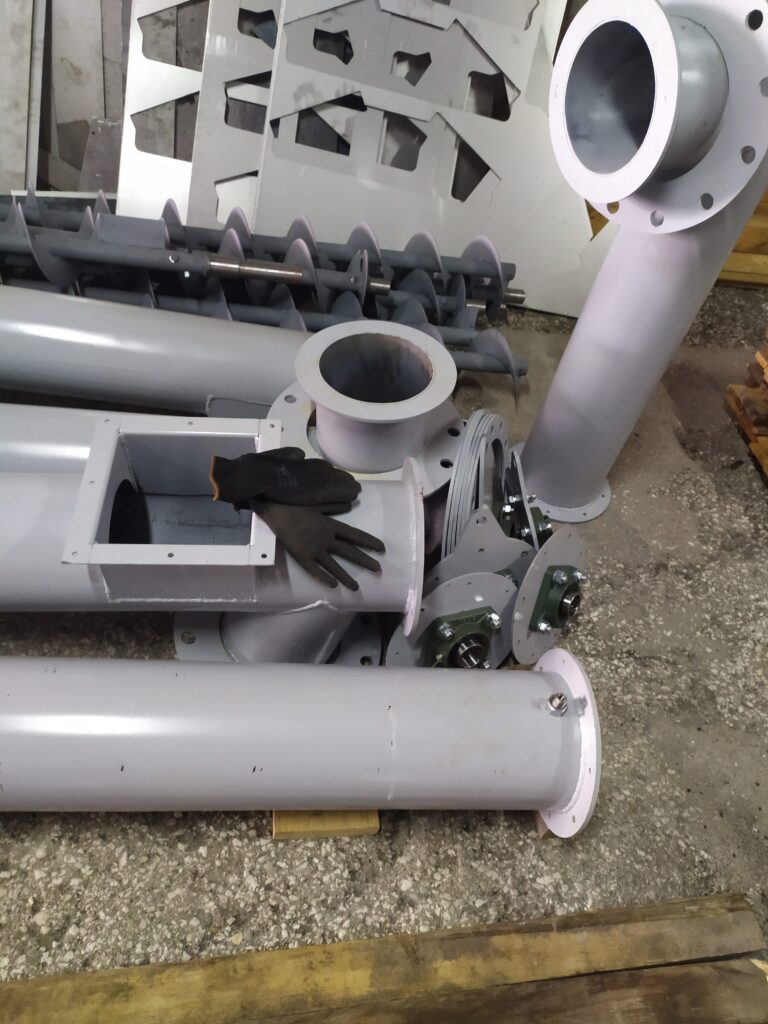
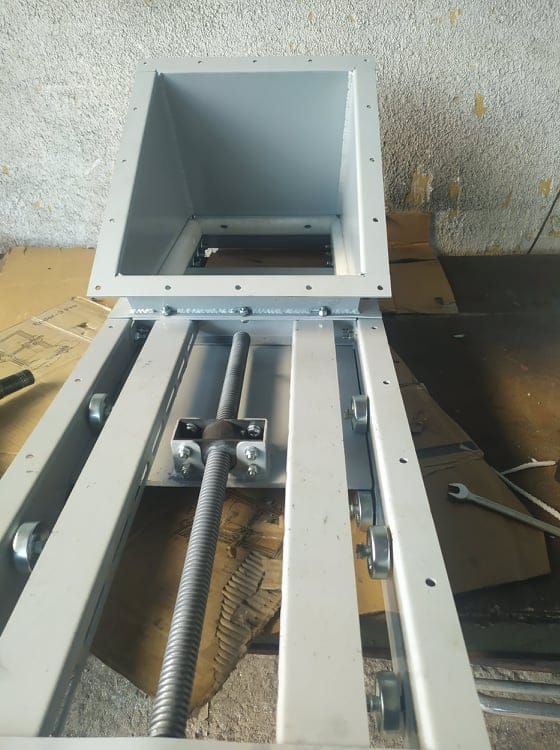
A slide gate is a sliding plate in a housing that opens or closes the opening. The opening can be square, rectangular or round – to match the hopper outlet and the inlet of the machine below. We build slide gates entirely in our workshop, so we can also make them in non-standard sizes, exactly to the flanges of existing equipment.
| Drive | When it is suitable | What to watch out for |
|---|---|---|
| Manual (lever, screw or chain wheel) | the gate is closed rarely – for repairs or a change of material | with a large opening and a tall silo the opening force is high, so gearing is needed |
| Electric | the gate is controlled from a panel and is part of the line automation | limit switches and jam protection |
| Pneumatic (cylinder) | fast opening and closing is needed, and compressed air is available on site | cylinder pressure and diameter matched to the opening force |
2. How large the opening should be
The opening must be large enough to prevent the material from bridging above it. For free-flowing granular materials, the rule of thumb is an opening at least 6–8 times the largest particle. For fine, moist and caking materials – cement, flour, wet sand – that is not enough. There, the opening size depends on the material properties and the hopper wall angle, and a vibrator or aeration is often added.
At the same time, the opening must match the flange of the machine below – screw conveyor, rotary valve or chain conveyor. So we size the hopper, the gate and the machine together, not separately.
3. How much force is needed to open it
When the hopper is full, the material presses on the plate from above. To open the gate, the friction between the plate, the material and the guides has to be overcome. Roughly:
F ≈ μ · p · A
where F is the force in N, μ is the friction coefficient (about 0.4–0.6 for steel and bulk material), p is the vertical pressure on the plate in Pa and A is the area of the opening in m².
The pressure above the outlet does not grow in proportion to the silo height. Part of the material’s weight is carried by the walls through friction, so in a tall silo the pressure above the opening levels off. For a rough calculation, a material height of 1.5–2 times the cone outlet diameter can be assumed.
Example. A 500 × 500 mm gate (A = 0.25 m²), material with a bulk density of 1.6 t/m³, effective height 2 m. The pressure is about 1600 · 9.81 · 2 ≈ 31,000 Pa. The opening force is 0.5 · 31,000 · 0.25 ≈ 3,900 N – about 400 kg. That is impossible by hand with a lever. So manual gates of this size are made with a screw or rack-and-pinion drive, and where the gate is opened often, an electric or pneumatic drive is chosen.
4. The material determines the design
| Material | What we provide |
|---|---|
| cement, flour, fine powders | seals along the plate and housing to prevent dust |
| sand, crushed stone, abrasive materials | a thicker or wear-resistant plate and replaceable guides |
| wet and sticky materials | cleaning openings so the plate does not jam |
| food and sensitive products | stainless steel |
5. Location and maintenance
The gate must be reachable and must open without dismantling anything around it. When opening, the plate slides out of the side of the housing, so free space at least as long as the plate is needed. Under a silo, the gate is usually above the dosing machine – screw conveyor or rotary valve. This way the machine below can be serviced without emptying the silo.
6. Common mistakes
- An opening smaller than the inlet of the machine below. Material is held back and the machine works below capacity.
- A manual gate that has to be opened often. After a few weeks nobody wants to open it, and it stays half open.
- No room for the plate. The gate is installed, but it cannot open fully because there is a wall or another machine next to it.
- An unsealed gate for powdered material. There is constant dust around it, and with cement, material loss as well.
What to send us
Tell us the material, the dimensions of the silo or hopper outlet, how tall the silo is and what is below it. Also tell us how you want the gate operated – by hand, from the panel or with air. A photo of the site helps a lot.
See also the slide gate valves and hoppers we manufacture.