When bulk material has to be moved a few metres within a process line, the first question about the screw conveyor is what the casing should be – a tube or a trough. At first sight the difference is only in the shape. In practice it determines the dust around the machine, the permissible incline, the feeding accuracy, how easy cleaning is and how quickly you can reach the screw flight during a repair. In this article we describe how each type is built, what it is suited for and how we choose between the two.
1. How the design differs
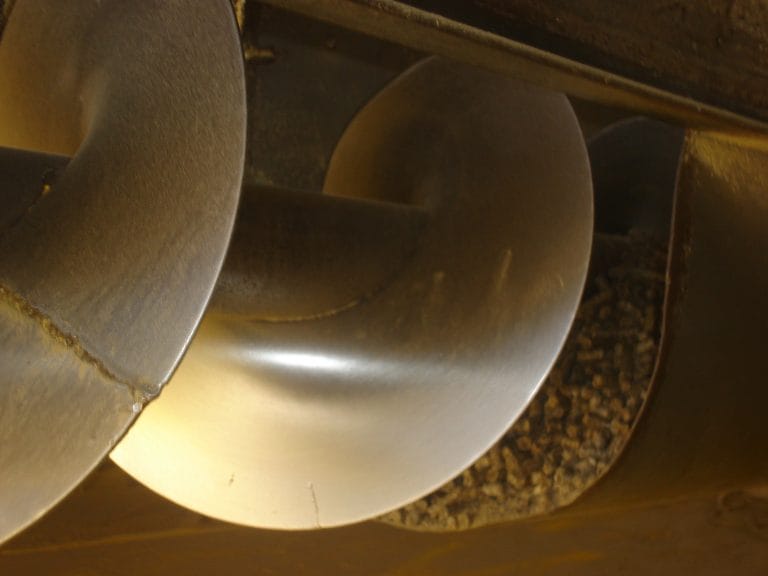
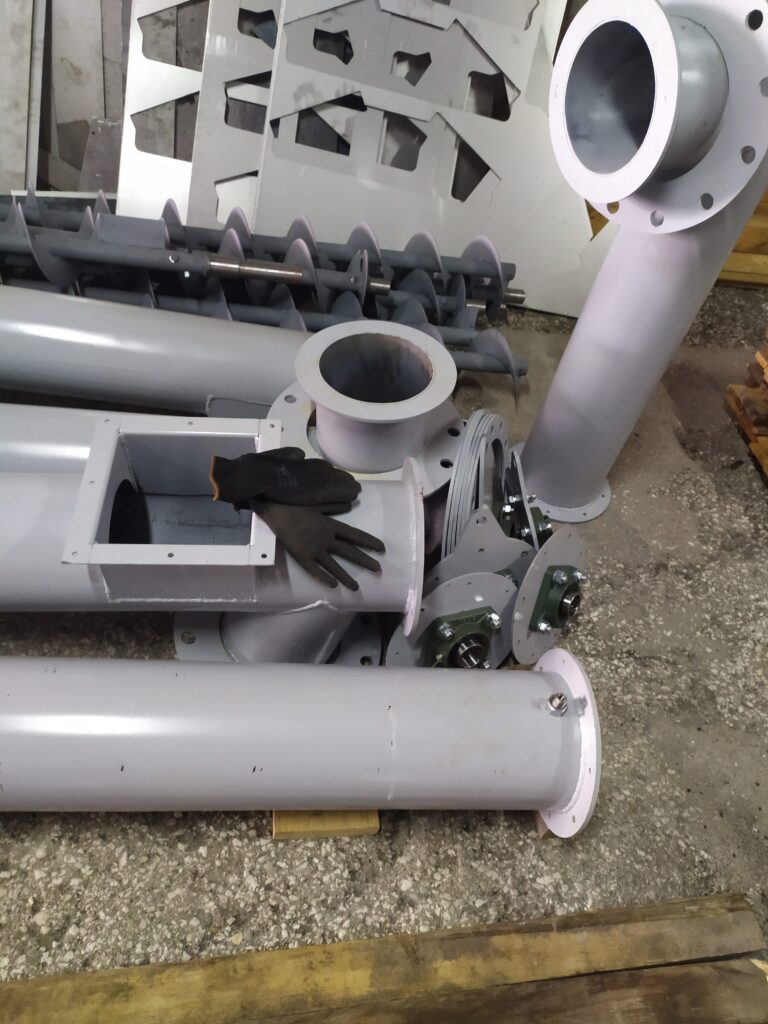
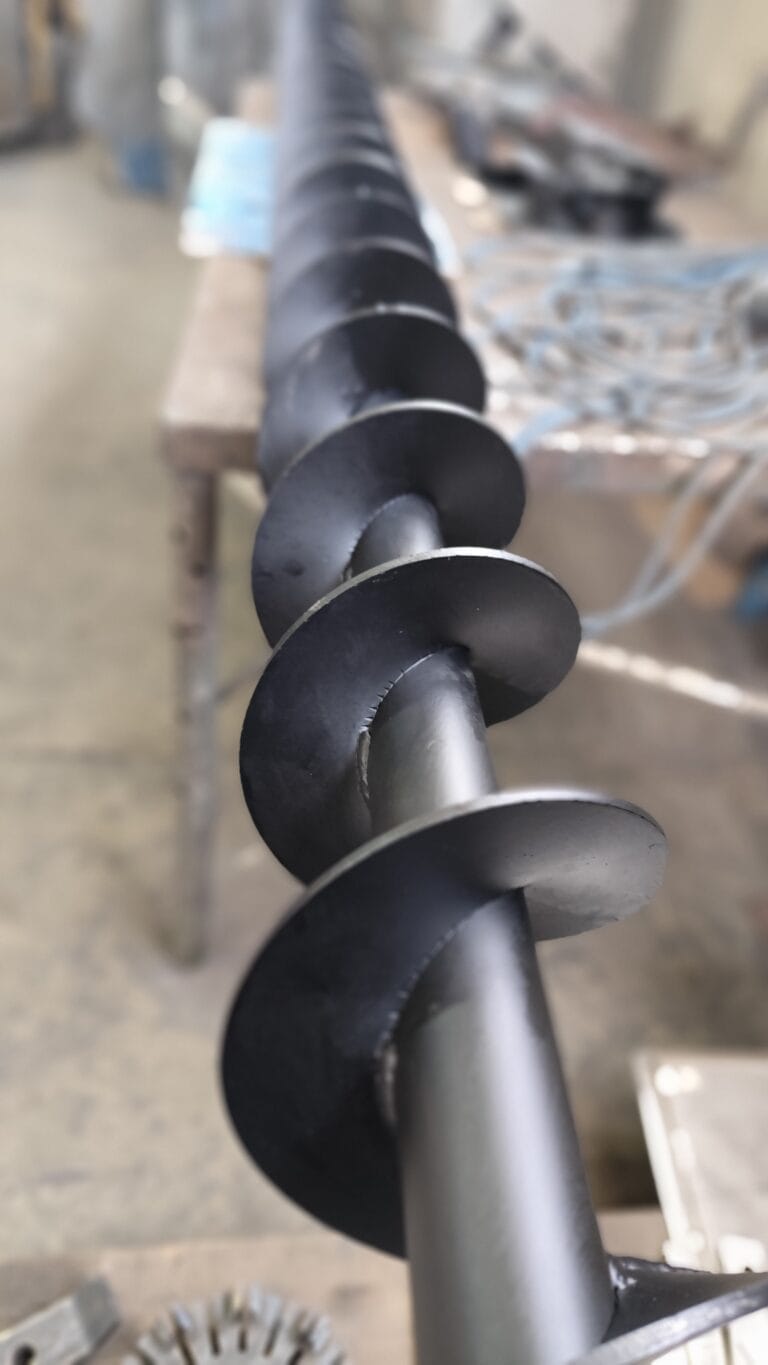
The tubular screw conveyor has a screw flight rotating inside a closed tube. The clearance between the flight and the tube is small – usually a few millimetres. As a result the material hardly flows back between the flight and the wall, which matters on an incline and when dosing. The tube is made of separate flanged sections, and the inlet and outlet are flanged, so the conveyor connects directly to a silo, hopper, weigh hopper or mixer.
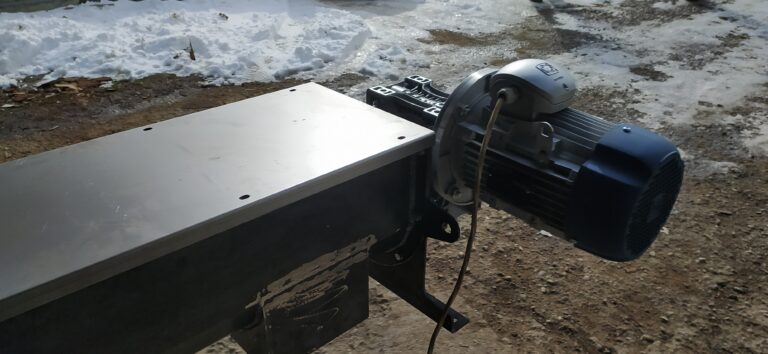
The U-trough screw conveyor has a U-shaped casing with covers on top, fixed with bolts. The clearance between the flight and the trough is larger. Inlets can be long – along the whole length of the trough – and there can be several outlets with slide gates, to distribute the material to different points.
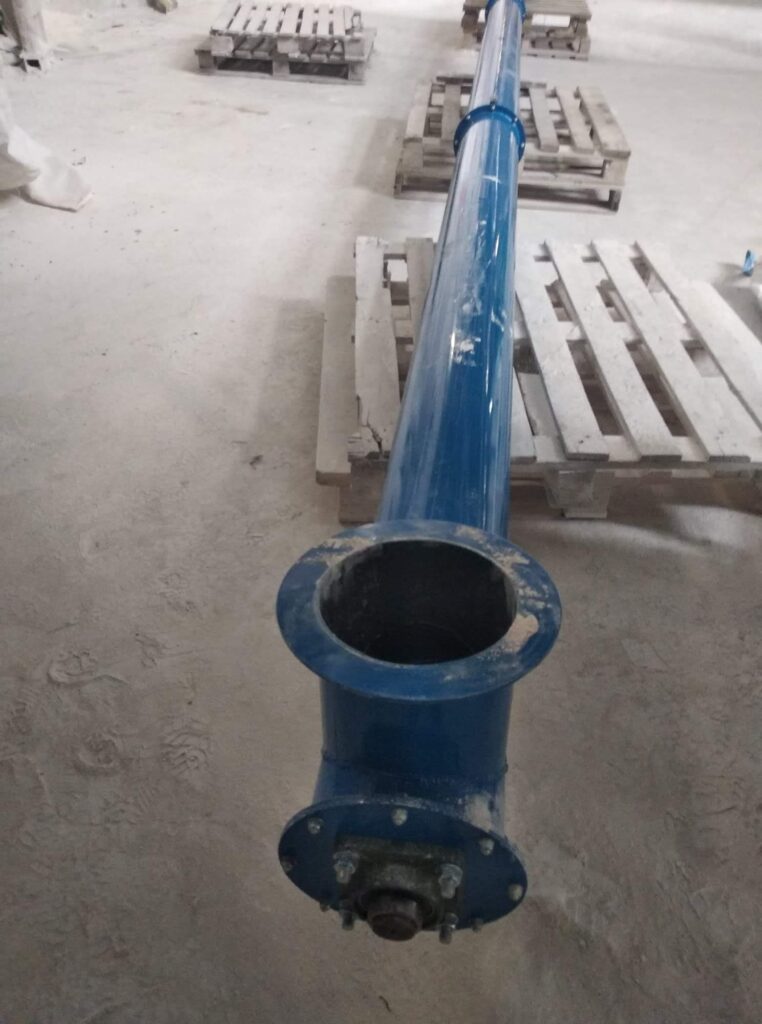
Tubular screw conveyor
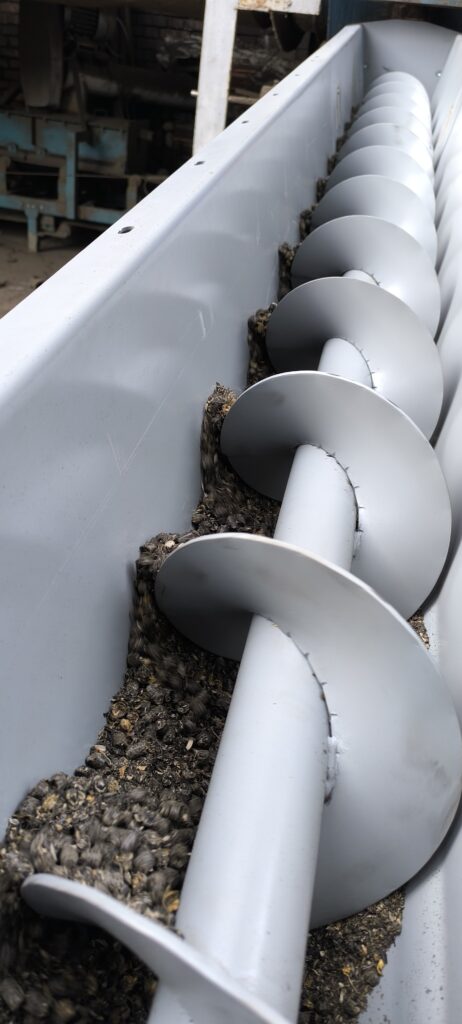
U-trough screw conveyor
| Tubular screw conveyor | U-trough screw conveyor | |
|---|---|---|
| Casing | closed tube of flanged sections | U-trough with removable covers |
| Flight-to-casing clearance | small | larger |
| Dust | fully enclosed | closed with covers, longer seals |
| Incline | works at steep inclines, up to vertical | best horizontal or at a small incline |
| Dosing | more accurate, especially on an incline | coarser |
| Cleaning | through inspection openings | by removing the covers |
| Sticky and wet materials | harder, higher risk of build-up | better suited |
| Many inlets and outlets | possible, but more complex | easy to add along the length |
| Wear | the flight is replaced, with heavy wear also the tube | the flight is replaced, with heavy wear also the trough |
2. When to choose a tubular screw conveyor
- Powdered materials – cement, lime, gypsum, flour, fly ash, where dust must not escape.
- Inclined conveying – for example from a silo to the mixer of a concrete plant or to a hopper at a higher level.
- Dosing under a silo or hopper, when the material has to be fed evenly.
- Outdoor installation – the closed casing protects the material from rain and moisture.
The tubular screw conveyors we build range from 60 to 630 mm in diameter and up to about 20 m in length in one machine, with a capacity of 5 to 200 m³/h depending on the diameter, pitch and material. For longer routes two conveyors are placed one after the other, or a different machine is chosen.
3. When to choose a U-trough screw conveyor
- Wet, sticky or fibrous materials – filter cake, sludge, wood shavings, fertilisers, oilseed cake, which stick to the walls.
- Coarse or uneven materials, where the tight clearance of a tube can cause the flight to jam.
- Long horizontal routes with several inlets or outlets – for example collecting from several machines or distributing to several hoppers.
- Large quantities of abrasive material – sand, slag, ash, where the flight wears faster and has to be easy to replace by removing the covers.
- Places where the machine is cleaned often or the material changes.
4. Filling, speed and incline
A screw conveyor is not filled to the top. In a horizontal conveyor, how much of the cross-section is filled depends on the material: free-flowing, light and non-abrasive materials allow a higher fill, while abrasive and heavy ones need a lower fill so that the flight and casing do not wear quickly. As a guide, the fill is between about 15% and 45% of the cross-section. For the same reason abrasive materials are conveyed at a lower speed.
As the incline increases, capacity drops because the material starts to flow back between the flights. As a guide, at 10° the loss is around 10–20%, at 20° about one third, and at 30° or more the capacity can fall by half or more. The exact value depends on the material, pitch and fill. That is why an inclined conveyor gets a shorter pitch, a larger diameter or a higher speed. A tubular conveyor handles inclines better, because the small clearance and the closed tube do not let the material fall back past the flight.
5. Bearings and seals
The end bearings are placed outside the casing, with a seal where the shaft leaves the tube or trough, so the material does not reach the bearing. On long conveyors the flight is also supported by intermediate (hanger) bearings. They sit in the material flow, and sticky material can build up around them, so in such cases we look for a design with fewer or no hanger bearings – for example a larger shaft diameter or two shorter conveyors.
6. Common mistakes when choosing
- A tubular conveyor for sticky material. The material sticks to the tube, the passage narrows and the geared motor is overloaded.
- A U-trough conveyor at a steep incline. Capacity drops far more than expected.
- Covers without seals for powdered material. There is constant dust around the machine.
- Capacity calculated with a full cross-section. On paper the conveyor is big enough, in operation it is not, because the real fill is much lower.
- No inspection openings. When it blocks, the conveyor has to be dismantled instead of being cleaned in place.
7. Five questions for a quick choice
- Is the material powdered and does the conveyor have to be fully enclosed? → tubular.
- Is it sticky or wet, does it contain fibres or large lumps? → U-trough.
- Is the incline above about 15–20°? → rather tubular.
- Are several inlets or outlets needed along the length? → rather U-trough.
- Is accurate dosing needed? → rather tubular.
What to send us
Tell us what the material is (bulk density, moisture, particle size, temperature), what capacity you need, the length and incline of the conveyor, how many inlets and outlets there are and where it will be installed. A photo or sketch of the site helps a lot.
See also the tubular screw conveyors and U-trough screw conveyors we build.